


The Making of The Argentera and The Tales of the Six Arabesques
I love real books for their feel, their textures, their substantiality. I think I absorb their stories not only by reading them, but also by their feel in my hands, a feeling I can’t really explain, but which has been with me since my childhood. And I love writing. I'm grateful that my publisher, Green Fire Press, loves that I love writing!
I began writing The Argentera and the Tales of the Six Arabesques with the desire to write about a six-hundred-year-old journal of jewelry designs, conceived and drawn by Asher, a fictional Jewish goldsmith from Alsace. What would happen if this journal was discovered in a secondhand bookstore by a twenty-first century jeweler, Miriam, (perhaps only slightly like me)? I really do love old books. Asher’s journal exists only in my imagination, though I have to admit that there were many times that I almost reached for it, as I was describing it in the novel.
The image below is close to what I was envisioning his journal might look like:

In the process of writing this novel, I felt compelled to design and create a neckpiece based on my description in the novel (the description in Asher’s journal), making tangible what had been, up to that point, a neckpiece I had only imagined as the central ‘character’ of the tales. That neckpiece appears on the front cover of the book and one pendant appears as a decorative dingbat above each chapter title. The neckpiece exists and is now well-loved in a private collection.
Making the necklace required a bit of engineering, because, what I had envisioned for Asher’s design included three individual chains from which were suspended six pendants (the arabesques). First, I had to design each of the pendants, each of which referred to historical handwoven textiles and carpets from the Middle East and India, patterns that have come to be described as arabesques. As with making art in any form, the challenge was integral to the process, and is one of my favorite parts of making my work.
The sketches below are for only five of the six pendants. I seem to have misplaced the sketches for the sixth pendant. A mystery yet to be solved.
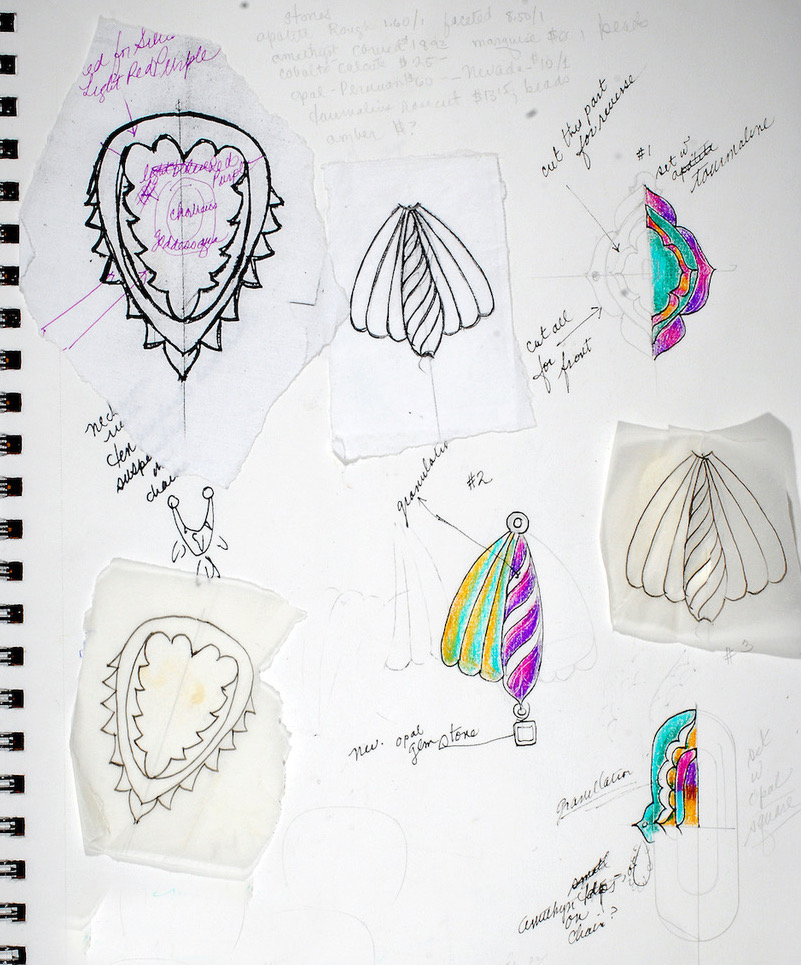


But the design of the pendants was not the only challenge. The three individual chains had to be joined to a clasp separately, so that each could be removed, and in the storyline, given to each of Asher’s daughters, with the remaining neckpiece retained by his wife.
Once the pendants and chains were conceived and drawn, I had to transfer the designs to metal clay, using hand-carved printing plates, then kiln-fire them, finish/polish them, and then enamel them using vitreous enamels.
I then fused fine silver links for the chains, in order to make loop-in-loop supports for the pendants and then joined the pendants to the chains. All of this happening while writing the novel. I was joyful!

Because I wanted to write about multiple periods of time, I needed to research many historical issues that would, if I didn’t get them right, affect the accuracy of locations, events, relationships, and more. In short, I needed information that would allow me to construct believable and accurate environments in which to imbed my characters; where they lived, how they lived, and what they ate and wore, in order to craft a believable story.
So I researched and researched and researched (another activity I love to do):
the Jews of Alsace;
the bubonic plague in Europe in the mid-fourteenth century;
the Venetian ghetto;
the production of textiles, particularly “cloth of gold”;
the lives of Andalusian Jews;
the kurgans and topography of the steppes of eastern Europe;
the kinds of looms and yarns used in ancient India, Persia and Andalusia, and, in 1349 CE;
the materials available for books (including inks, paints, substrates);
the tools in 14th century jewelers’ workshops;
the garments worn in Milan then;
Milanese food then;
Geography and topography between Alsace and Milan;
Historically accurate Jewish and other names
(choosing those that suited the characters and when spoke aloud
were pleasing to me.);
I read books on the Scythians, Venice and Islam, the Black
Death and the Colmar Treasure;
Venexia of the mid-1300’s and the 1920’s.
I also chose to include words in the Venetian language, Venet, since I love the sounds of languages, and wanted to make certain that when my Venetian characters spoke, if I wanted to insert expressions or expressive words, they spoke mostly in Venet, (and then hoped I got it right).
As a maker of things, a studio jeweler, it was important for me to write about weavers, jewelers, decorative furniture makers, sculptors, and glass workers, art conservators, etc. Having been immersed in the world of craft art for almost 50 years, it was almost a given that I would write about jewelry and other media. I just couldn’t help myself. I wanted this to be an acknowledgment of the power of the handmade objet.
The first rule for writers has always been ‘write what you know.’ Then find out what you don’t know, learn it, and use it well. Then fall in love with what you have learned and used. I did.
To order the book, go to your independent bookstore or order from


Comments